
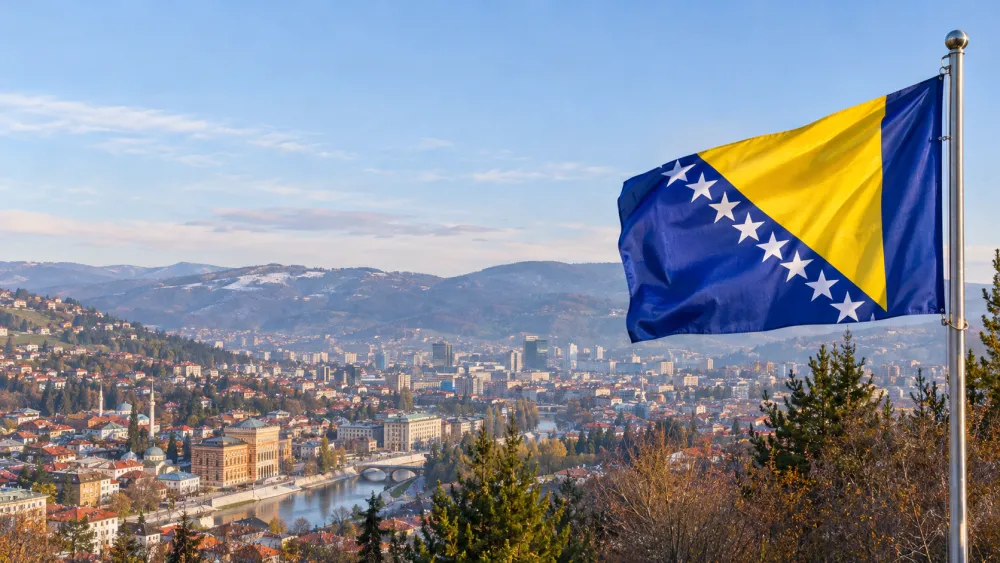
On November 25, 2026, our homeland, Bosnia and Herzegovina, celebrated Statehood Day!
We remind you, dear ABC boys and girls, that the First Session of ZAVNOBiH was held on November 25, 1943, in Mrkonjić-Grad. It laid the foundations for restoring the country's statehood and affirmed the principle of equality among its peoples.
This year's Statehood Day observance began on Wednesday morning, November 25, on Mount Hum above Sarajevo, where the flag was ceremonially raised to the sound of the national anthem. The ceremony was attended by Denis Bećirović, Chair of the Presidency of Bosnia and Herzegovina; Igor Stojanović, Vice-President of the Federation of Bosnia and Herzegovina; Sarajevo Mayor Samir Avdić; and many other officials.
“This is one of the most magnificent dates in our long history,” said Mr. Denis Bećirević, adding that the ZAVNOBiH delegates had made all the citizens and peoples of Bosnia and Herzegovina proud. “Statehood Day is not a holiday that discriminates against or excludes anyone; it is a holiday that brings people together,” Bećirović said. Ceremonial receptions for this national holiday were held at City Hall and the Presidency Building of Bosnia and Herzegovina. Presidency members Denis Bećirević and Darijana Filipović welcomed many guests at the Presidency of our homeland.
Throughout its history, Bosnia and Herzegovina passed through different state and administrative frameworks: Ottoman and Austro-Hungarian rule, the Kingdom of Serbs, Croats and Slovenes, and then the Kingdom of Yugoslavia, in which it lost its status as a separate administrative unit. During the Second World War, decisions made at ZAVNOBiH in 1943 restored its statehood. As we noted, the First Session of ZAVNOBiH began at 7 p.m. on November 25, 1943, and ended at four o'clock the following morning. It functioned as a constituent assembly, at which ZAVNOBiH was established as the central political representation of the National Liberation Movement and the highest body of popular authority in Bosnia and Herzegovina. The participants adopted the ZAVNOBiH Resolution and the Proclamation to the Peoples of Bosnia and Herzegovina, along with documents affirming the country's right to decide its own future and to have its interests represented by legitimate institutions established within the anti-fascist movement. Thus, Mrkonjić-Grad, a town in the western part of the country where the first session took place, remains one of the key historic places connected with the restoration of Bosnia and Herzegovina's statehood. Its name in public life often receives extra attention on November 25, when Statehood Day is marked.
As mentioned, this year's Statehood Day observance began in Sarajevo with a ceremonial raising of the national flag on Mount Hum, accompanied by the national anthem. Numerous delegations laid flowers and paid their respects at important memorials, including the Eternal Flame, the Kovači cemetery, the Memorial to the Murdered Children of Besieged Sarajevo, and Vraca Memorial Park. On this holiday, Sarajevo also hosted many cultural, artistic, and educational events. A particularly interesting event for the youngest visitors was the performance “Stories from the Bosnian Court,” while pupils from elementary and secondary schools received awards for the best art, literary, and video works dedicated to Bosnia and Herzegovina.
A ceremonial music and stage program, “Defiant and Proud,” was held at the Bosnian Cultural Center, featuring artists from different generations. Statehood Day was also marked in Mrkonjić Grad, where the memory of the site of the historic 1943 session is kept alive. Ceremonies, flower-laying, cultural events, and community gatherings were organized in other cities across Bosnia and Herzegovina, including Mostar, where the observance took place at the Partisan Memorial Cemetery.
Especially lovely scenes celebrating Statehood Day also came from abroad. Our people living far from their homeland did not forget their holiday; they marked it with gatherings, social events, cultural programs, and presentations of Bosnian-Herzegovinian tradition. In Sydney, Australia, the Bosnian-Herzegovinian community held a formal gathering attended by representatives of diplomatic and civic life, many families, and friends of Bosnia and Herzegovina. Messages of unity, friendship, and preserving language, culture, and tradition were shared. A particularly interesting event took place in the English city of Birmingham. For the first time, the national flag of Bosnia and Herzegovina was ceremonially raised in front of Birmingham City Council, one of Europe's largest local administrative centers. Our country's flag flew in the heart of this British city on November 25.
In London, the Embassy of Bosnia and Herzegovina organized the opening of the exhibition “When Light Echoes Music,” dedicated to the artistic work of Bosnian-Herzegovinian artist Mirsada Baljić. The celebrations continued at the Bosnian House in Birmingham, where members of the community from different parts of the United Kingdom gathered with guests from Bosnia and Herzegovina and other European countries.
In Oslo, Norway, Statehood Day was marked with a formal reception at the Embassy of Bosnia and Herzegovina. The first of ten artistically crafted stećak tombstones, which will adorn Bosnia and Herzegovina's embassies around the world, was also presented. The event offered an opportunity to showcase the country's rich cultural and historical heritage. A particularly beautiful scene also came from faraway Canada, where the magnificent Niagara Falls were illuminated in blue and yellow, the colors of our national flag, for Statehood Day—a symbolic message that love for the homeland and its symbols are cherished around the world.
So, dear ABC pupils, Bosnia and Herzegovina's Statehood Day is more than just a date on the calendar. It is an opportunity to remember the history of our country, learn about its cities, natural beauty, cultural heritage, and the people who have contributed to its development through their knowledge, work, and creativity. It is especially important for children and young people—whether they live in Bosnia and Herzegovina, Germany, Austria, Sweden, Australia, America, or another country—to learn about their homeland and stay connected to its history, language, and traditions.
Because Bosnia and Herzegovina is not only the place where we live. It is also a story we learn, a heritage we protect, and a future we build together.
May we all have a happy Statehood Day in our one and only homeland!