
LIFE ON EARTH IN THE SUN’S EMBRACE
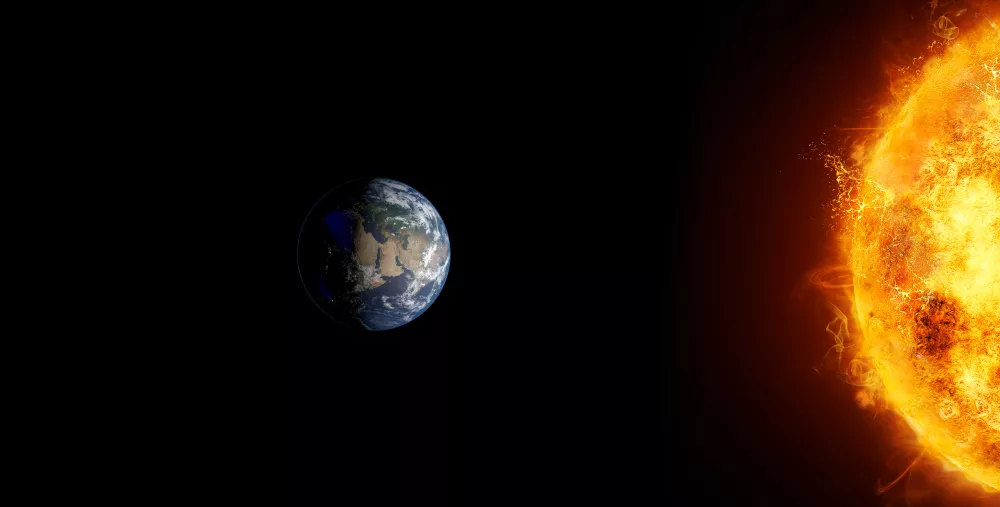
In the height of summer, the Sun seems like a constant companion to our days and nights, from sunrise to sunset. Meanwhile, our planet Earth also travels across the sky each day, guiding nature’s rhythm with astonishing precision!
The Sun does not move around Earth. Our planet rotates on its axis while traveling around the Sun. This interplay of gravity, rotation and orbit determines our days, the seasons and changes in day length. Earth spins on its axis every twenty-four hours, causing day and night. As Earth continues turning through the night, each region moves into the sunlight and a new day begins. Earth travels around the Sun in an elliptical orbit, completing the journey in about 365 days. The Sun’s apparent movement across the sky is caused by Earth’s rotation as our planet follows its orbit.
Earth’s axis is tilted in relation to the plane of its orbit around the Sun. This tilt changes the Sun’s position in the sky and causes the seasons. In the Northern Hemisphere, when the northern half of Earth is tilted toward the Sun, it is summer, while the Southern Hemisphere has winter. These motions form the cycle that surrounds us each day and is essential to life on Earth. Whether we watch a sunset at the beach or work in an office, understanding these natural processes helps us understand our world and appreciate our planet’s complexity. The Sun is the source of life and energy for Earth. Shining high in the sky, it is at the heart of our solar system and essential to life as we know it. The Sun is an enormous ball of plasma. Through nuclear fusion, hydrogen turns into helium, releasing great amounts of light and heat. This energy reaches Earth as electromagnetic radiation, including visible light and infrared rays, enabling plants to photosynthesize and warming the atmosphere.
It is interesting, dear ABC Djeca readers and older readers too, that the Sun has layers: a core, radiative and convective zones, and a photosphere. Its diameter is about 1.4 million kilometers, making it several hundred times larger than Earth. Dark sunspots and bright solar flares on its surface reveal complex processes in its atmosphere. The Sun plays a key role in sustaining life on Earth! Its radiation makes photosynthesis possible, the foundation of our planet’s food chain. Its heat also affects circulation in the atmosphere and oceans, shaping weather and climate. Changes in solar activity—including solar cycles and the solar wind, which affects the magnetosphere—can have a significant impact on Earth. Scientists around the world study the Sun carefully to better understand its processes and influence on our planet. Satellites allow continuous monitoring of solar activity, while space probes study the solar corona and solar wind.
The Sun has been central to religions, mythologies and cultures around the world throughout human history. It symbolizes life, strength, light and renewal. Many civilizations worshipped it and tried to understand its power and influence on everyday life.
As the Sun continues across the sky, it reminds us of the universe’s wondrous complexity and our dependence on this celestial body. Studying the Sun is essential to understanding life on Earth and to our future in space exploration. We will keep admiring its beauty, and you, our youngest ABC Djeca readers, keep learning as much as you can about sunlight and its journey across the vast, boundless sky.