
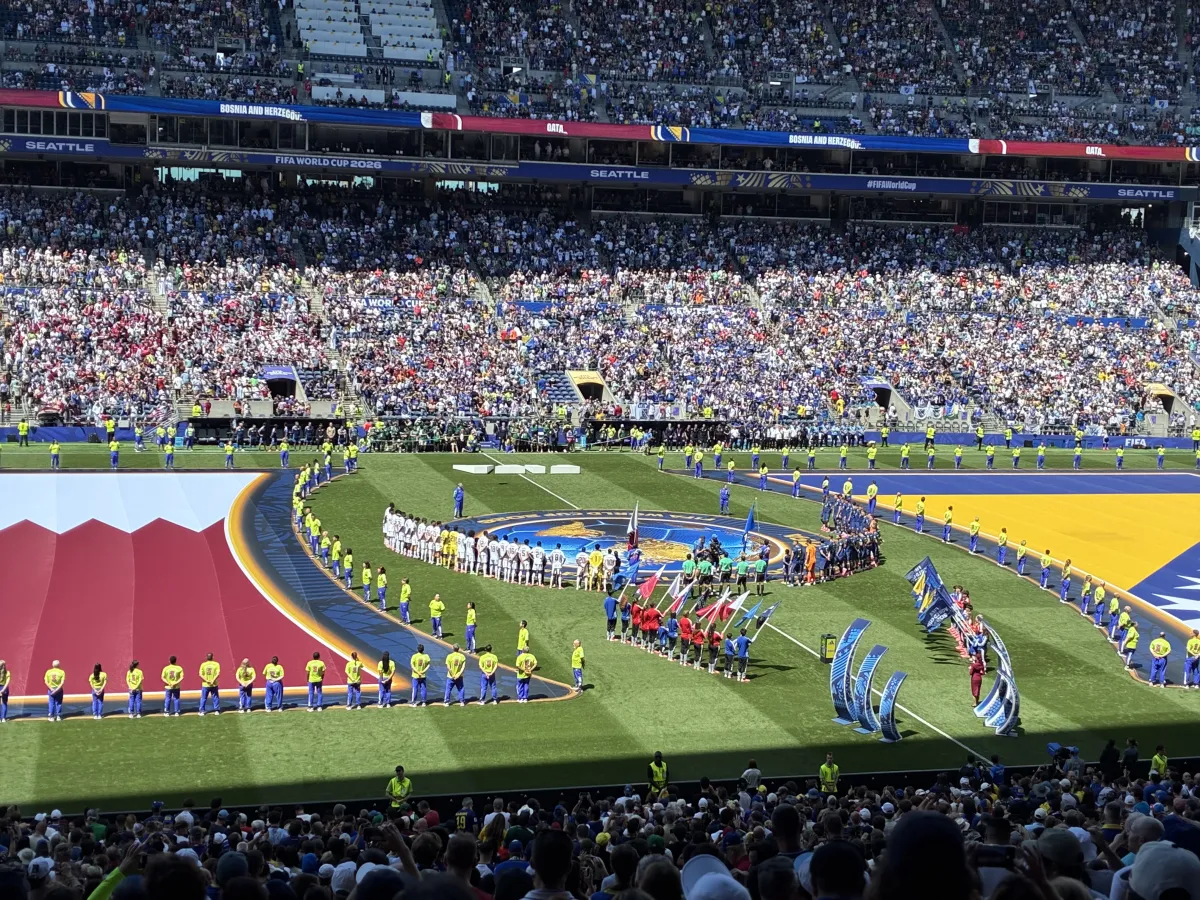
A country united by football
Dear ABC boys and girls, the historic 2026 FIFA World Cup was held in Canada, Mexico and the United States. The tournament ran from June 11 through July 19, 2026. In sport, a referee’s final whistle rarely means so much. After Bosnia and Herzegovina’s qualifying match against Italy ended with an epic penalty shoot-out and confirmed the country’s return to the World Cup, the moment did more than celebrate a sporting achievement: it recalled a journey lasting more than a decade. That journey began in Brazil in 2014 and continued through years in which the national team became more than a team, and its supporters became more than spectators. Bosnia’s appearances on the world stage tell a story of passion and love for sport and homeland. They may be brief, but they leave a deeper mark than the numbers alone can show.
The first World Cup: Brazil 2014
Bosnia and Herzegovina’s first World Cup remains a foundation of shared memory and of its first great emotions on the world stage. In Brazil, the team played three matches before more than 163,000 spectators, averaging about 54,000 per match—attendance figures that still rank among the highest for the tournament’s group stages. Maracanã, Cuiabá and Salvador became symbolic places in a sporting awakening. In the match against Argentina, nearly 75,000 people watched Bosnia and Herzegovina score its first goal in World Cup history. That goal did not change the standings, but it changed perceptions: even a small football nation could leave its mark in the world’s biggest stadium. Brazil 2014 meant more than the scores 1–2, 0–1 and 3–1. It showed that the team could compete with the strongest sides, carried by a special moment and a generation of outstanding players.
Bosnian supporters across the world
In the years that followed, Bosnia and Herzegovina showed that it had not only a national team, but a worldwide audience. Supporters came not just from Sarajevo, Mostar and Tuzla, but also from Berlin, Chicago, Melbourne and Stockholm. At every new tournament, the scene was familiar: thousands of Bosnian flags in the stands, songs rising above the home crowd, and the feeling that we were the hosts. Football became a moment when distance disappeared and identity became the only currency. No change needed!
2026: Bosnia among the best
The 2026 World Cup was played in three countries for the first time—the United States, Canada and Mexico—and had the largest format in the tournament’s history: 48 national teams, 104 matches and stadiums that were almost always full. Bosnia and Herzegovina found its place in this global setting once again. The group stage brought four points, five goals and a fight that lasted until the final round. A 1–1 draw with Canada in Toronto, watched by 43,002 people, opened the tournament with both caution and hope. The match against Switzerland in Los Angeles, before more than 70,000 fans, showed the difference between experience and ambition (1–4). Then a 3–1 win over Qatar in Seattle brought back the feeling that the story was not over and Bosnia was moving forward with the same determination. Nearly 180,000 spectators watched the three matches, an average of about 60,000 per game, putting Bosnia and Herzegovina among the most watched teams in the group stage. More important than the figures was the impression the team made: it had come not merely to play, but to stay in the competition for as long as possible.
Statistics do not tell the whole story
On paper, Bosnia and Herzegovina finished the group as a middle-ranking team: five goals, four points, one win, one draw and one defeat. Yet statistics cannot explain what happened in the stands and around the pitch. Behind every number was another picture: thousands of supporters crossing oceans, flags appearing in cities where Bosnia and Herzegovina had never played, and a national team with an audience that did not depend on the result.
For Bosnia, it is more than a game
The country’s World Cup story is not a straight line. It is a series of unforgettable scenes: the first goal in Brazil, the diaspora turning stadiums around the world into home ground, and the 2026 campaign and another effort to remain among the best. One idea connects them all: Bosnia at the World Cup is more than a national team. For 90 minutes, a country scattered across the world gathers together in one place.
Perhaps that is the greatest victory—not a place in the standings, but the fact that Bosnia still has somewhere to return to. As it has done countless times over a thousand years, Bosnia has returned to itself: to its cities, little streets and neighbourhoods, mountains and rivers.
Dear ABC fans, wherever you are, may these moments stay written in our memories: we were never written off, and we never will be. The scent of lilies spreads across the fields. A correction: across every field on this colourful planet, the scent of lilies is spreading.
And Bosnia and Herzegovina is the perfect ending to this song!