
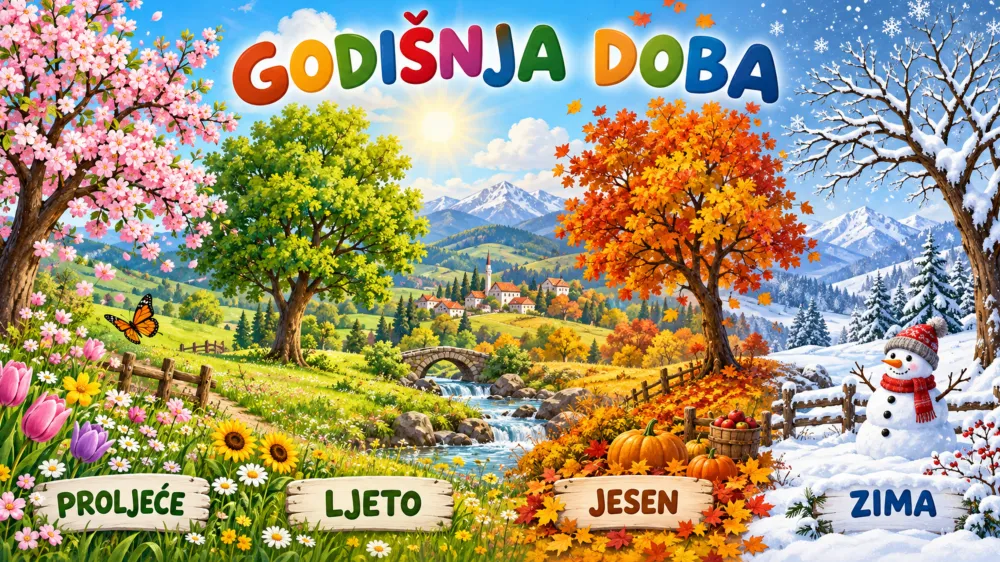
Dear ABC children, have you noticed that the same tree sometimes has green leaves, sometimes yellow ones, and sometimes completely bare branches? One day we wear shorts, and a few months later we reach for a hat, scarf, and gloves!
Why does nature change? Because four seasons take turns throughout the year: spring, summer, autumn, and winter.
Each brings its own colours, scents, and exciting adventures. Let’s explore them with Zmajko and Lilly!
Spring: Nature wakes up
One morning, Lilly spotted a little flower peeking out of the soil.
“Zmajko, look! Spring is here!”
Zmajko bent down to get a closer look.
“It’s so tiny! We have to watch where we step.”
In spring, the days grow longer and the weather gets warmer. Buds appear on branches, grass grows, and many plants bloom. Migratory birds, such as swallows, return from warmer places.
Bees visit flowers, and parks and meadows fill with life again. Sometimes rain surprises us, so a light jacket and a pair of rain boots can come in handy!
A little spring mission: Choose a tree near your home. Watch it for a few weeks. When will you spot its first tiny leaves?
Summer: Sunny days and long evenings
“Who’s ready to play?” called Zmajko, carrying a ball.
“I am! But first, a hat and sunscreen,” Lilly reminded him.
In summer, the days are long and the nights are short. It is the warmest season, when many of us enjoy school holidays, outings, and swimming.
All kinds of fruit ripen in gardens and orchards. A slice of watermelon, a peach, or a handful of raspberries can be a delicious treat after playing.
Still, the sun can be very strong. So we drink plenty of water, take breaks in the shade, and always stay near water with an adult watching over us.
A little summer mission: Close your eyes while sitting somewhere safe in the shade. What can you hear? Birds, buzzing insects, rustling leaves, or babbling water?
Autumn: The colourful magic of leaves
Lilly picked up a yellow leaf, and Zmajko found a red one.
“Look at all these colours!” said Lilly.
“It’s as if someone painted the whole park!” Zmajko laughed.
In autumn, the days grow shorter and the weather cooler. The leaves on many trees change colour and fall. Yellow, orange, red, and brown leaves rustle beneath our feet.
Apples, pears, and other autumn fruits ripen. Some animals gather food for later, and many migratory birds leave for warmer places.
But not every tree loses its leaves! Pine and fir trees usually keep their green needles through the winter.
A little autumn mission: Collect a few leaves that have already fallen to the ground. Compare their colours, shapes, and sizes. Can you make a picture with them?
Winter: Chilly days and cosy scarves
Zmajko peeked out of the window.
“Lilly, look! Snowflakes! Shall we build a snowman?”
“Yes! Just promise you won’t warm his nose with your dragon breath!”
Winter is the coldest season. The days are short and the nights are long. In some places there is lots of snow, while in others there is little or none.
When snow covers the ground, we can go sledding, build a snowman, and look for tracks in the snow. We put on a warm coat, hat, and gloves so we can enjoy playing outside.
Some animals spend much of the winter in their shelters, while others stay active and look for food.
A little winter mission: Look at the trees where you live. Which ones are still green, and which have bare branches? If there is snow, look for the tracks of birds and other animals.
Why do the seasons change?
Our planet Earth travels around the Sun. It takes about one year to make a complete trip.
Earth is tilted a little as it travels. Because of this tilt, different parts of Earth receive different amounts of sunlight during the year.
When our part of Earth tilts toward the Sun, the days are longer and the Sun’s rays warm us more directly. That is when it is summer here. When it tilts away from the Sun, the days are shorter and we receive less warmth from the Sun. That is when it is winter. Spring and autumn come in between.
Did you know? When it is winter in Bosnia and Herzegovina, it is summer in Australia! And in some parts of the world, the seasons look different, with rainy and dry periods standing out more.
Let’s play: Guess the season!
Read the clues and try to guess the answer before you look at the solutions!
- Flowers open, buds grow, and swallows return. Which season am I?
- The days are long, the weather is warm, and we especially enjoy the shade. Which season am I?
- Leaves change colour and rustle underfoot, and the days grow shorter. Which season am I?
- We wear gloves and scarves, and sometimes snow delights us. Which season am I?
Answers: 1. Spring. 2. Summer. 3. Autumn. 4. Winter.
Draw a year on one sheet of paper
Divide a sheet of paper into four parts. In each part, draw the same tree in a different season:
- Spring: Add buds, little flowers, and young leaves.
- Summer: Draw a lush green crown.
- Autumn: Colour the leaves yellow, orange, and red.
- Winter: Draw bare branches and, if you like, add snow.
Write the name of the season under each drawing. Now you have your own little picture calendar!
“I love all four seasons!” said Zmajko.
“Me too,” added Lilly. “There’s something new to discover in every one.”
Which season do you like best, and what are you especially looking forward to?