
The Forest Wealth of Bosnia and Herzegovina
Early each morning, countless forests awaken across the boundless mountains of Bosnia and Herzegovina! They set out along endless sunlit trails, through evergreen conifers and broad-leaved woods, standing among our greatest treasures. These three magnificent gifts of nature—water, air, and soil—we must care for tirelessly, from one morning to the next. And it may sound unbelievable, but it is true: nothing anywhere is more beautiful or more fragrant than a tree!
Let’s take it one step at a time…
At dawn, sunlight bathes countless leaves. Forests, fields, and mountains surround us. Beech, oak, fir, spruce, pine, hornbeam, maple, ash, and many other kinds of trees grow together to form a variety of forest communities. Forests are home to many species of birds, mammals, insects, fungi, and other living things. In fact, they are enormous natural homes that protect springs, streams, and rivers, hold water in the soil, and reduce erosion and runoff. Trees help keep the air clean: through photosynthesis, they absorb carbon dioxide and release oxygen. Forests also nurture fungi and medicinal and aromatic plants, provide wild fruits, honey, and other useful products. Tree roots protect the soil from being washed away and from erosion. Forests soften high temperatures, create shade, and affect the moisture in the air. They also provide natural habitats and living space for many wild animals. At the same time, forests are important to Bosnia and Herzegovina’s economy and have great value for tourism, recreation, and health.
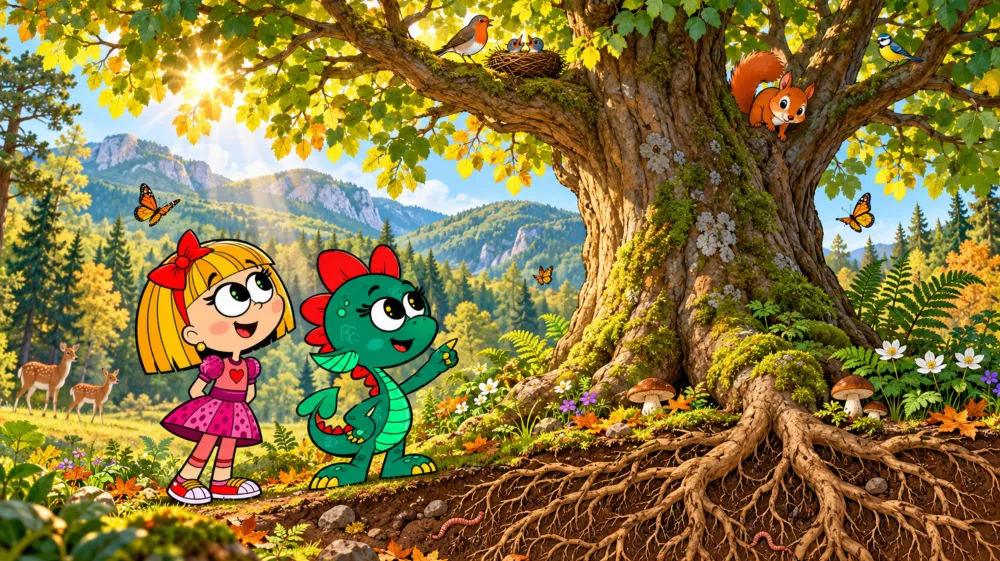
As sunlight filters through the treetops, the roots do their work deep underground. So, dear ABC children, let’s talk a little about the importance of roots. They anchor a tree in the soil, absorb water and minerals, and help keep the soil connected and protected from erosion. Beneath every tree, hidden worlds of fungi, bacteria, tiny organisms, and many other living things are at work. The leaves are just as important to nature. They make food for the tree, help produce oxygen, absorb carbon dioxide, and provide shade. By releasing water vapor, they also influence the air’s humidity and temperature. That is why a forest is a great natural system that sustains life!
When the sun climbs high, treetops form an endless “green roof of nature.” The forest is often more pleasant and cooler than an open space. Its shade protects soil, plants, animals, and people, while the mountains keep sending their fresh scents through the air. Forests become a natural climate system, a place to learn, and a home—just like our villages, mountains, and cities.
A single large tree can be a little hotel for nature! Birds, squirrels, owls, insects, and countless other creatures may live in its crown. And who knows what other plants and animals might be there… Birds and small mammals can hide in tree hollows, while many tiny residents live beneath the bark and in the nearby soil. And the forest as a whole is home to many larger animals, too: roe deer, red deer, wild boar, foxes, bears, wolves, and many other species.
Now, let’s talk about a few more gifts from the magnificent FOREST!
Trees offer more than shade and oxygen. Some also give us fruit and seeds that people and animals can eat. In our forests we can find, among other things, beechnuts, acorns, wild apples, wild pears, berries, and other edible gifts from nature. Acorns are an important food for many animals, while seeds and fruits help forests grow again.
Different kinds of trees grow on the mountains, hills, and in the valleys of Bosnia and Herzegovina. Some of the best known are beech, fir, spruce, oak, hornbeam, pine, maple, and ash. The special value of our forests lies in much more than their timber. Their riches include water, soil, plants, animals, fungi, clean air, and an enormous variety of life.
Forest soil absorbs rainwater and helps hold it. Roots and forest floor slow the flow of water, reduce erosion, help preserve springs and streams, and protect against flash floods. That is why forests are so important to the rivers of Bosnia and Herzegovina!
When the sun sets, the forest does not pause for even a moment. During the day, many birds, butterflies, and other daytime animals are active. At night, owls, bats, hedgehogs, many kinds of insects, and other animals begin their lives. The tree rests, but forest life continues its great natural cycle.
And what happens when a tree grows old?
It is still useful! An old or fallen tree can become shelter for insects, a home for fungi, a place where animals nest, and food for many organisms. Eventually, it becomes part of the soil. In this way, the end of one tree’s life becomes the beginning of life for many other creatures! As nature lovers say: “…One day in the life of a tree is really one day in the life of an entire forest.” With its roots, a tree protects the soil; with its leaves, it makes food and oxygen; with its crown, it provides shade; with its fruit, it feeds people and animals; and its trunk gives a home to many living things.
So, let’s remember this as we finish: “When we protect one tree,” we are really “protecting the forests”!!!!
Our homeland, Bosnia and Herzegovina, has a great wealth of forests. It is our shared responsibility to keep them healthy for future generations, too!
Until our next topic, warm greetings from our valleys, embraced by the beautiful autumn colours of Bosnia’s forests.