
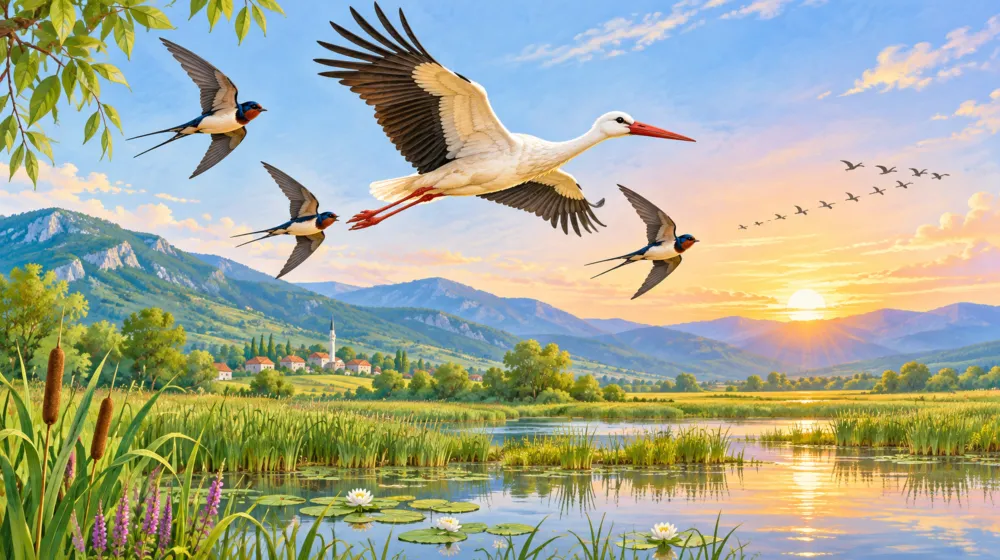
As we said, so we did! Here we are, dear ABC Djeca, among the many MIGRATORY BIRDS!
The months of September, October, November, and December 2026 are dedicated to migratory birds.
Let’s learn as much as we can about them. Let’s start at the beginning.
Who are these birds that make our lives more beautiful, and what are they?
Migratory birds are extraordinary, wondrous travelers of nature! Every year they cover hundreds, thousands, and even tens of thousands of kilometres in search of warmer places, food, and suitable nesting sites. The most beautiful stop along bird migration routes in our remarkable region lies between Central Europe, the Adriatic Sea, and Southeastern Europe. After winter, many birds return to our region in spring to nest and raise their young. In autumn, they head towards the warmer regions of Africa and the Mediterranean, and so another year passes….
Do any of you know, dear ABC Djeca, why birds migrate? Who sends them away, and who—or what—brings them back in spring?
Dear children, birds leave and return because of changing day lengths, the abundance of insects and other food, and places suited for nesting. In our forests and meadows, and beside rivers and wetlands, birds build nests and feed their chicks. When autumn turns cold and food becomes scarce, many species set off for the Mediterranean and Africa. Birds spend winter where food is easier to find, then return north. Bosnia and Herzegovina is full of migratory birds. The species seen in BiH while nesting, passing through, or spending the winter vary by area and year.
A large bird with long red legs and a red beak nests in towns and on rooftops, and usually spends the winter in Africa.
The barn swallow, or Hirundo rustica, builds nests in barns and beneath eaves. It feeds on flying insects and heads to Africa for winter. Swallows spend almost their entire lives in flight. They arrive in spring and set off for Africa at the end of summer.
The common cuckoo, Cuculus canorus, is known for its distinctive call. It lays its eggs in the nests of other birds and spends the winter in Africa.
One of the best-known “singers” in our thickets and gardens spends the winter mostly in sub-Saharan Africa. What about the nightingale? Does it still sing in our valleys and hills? Cranes, or Grus grus, are known for flying in large flocks shaped like a V during migration. Some flocks pass through the wider Balkans during the usual migration periods.
Next on the ABC School list is the colourful bee-eater, which hunts bees, wasps, and other flying insects. It also nests in earth banks and regularly winters in Africa. The famous European roller is easy to recognise by its blue and turquoise colours. It lives in open areas with trees and spends winter in Africa. The turtle dove lives in copses, hedgerows, and farmland. This migrant needs safe habitats in both Europe and Africa. The grey heron lives beside rivers, lakes, and wetlands. Part of the population stays all year, while other birds migrate or move to areas with more food. Other migratory birds and seasonal visitors in our country include the white wagtail, redstart, willow warbler, common cuckoo, black stork, harriers, eagles, various ducks, snipes, and wetland birds. They are not all migrants in the same way: some are resident, while others migrate only part of the time. Their routes differ, too. Some fly by day, others at night, and many stop to rest and feed.
Dear children, listen and find out where migratory birds can be watched in our homeland!
Let’s start with Hutovo Blato in Herzegovina, one of the most important wetland habitats in the country. Marshes, reed beds, and lakes provide food and resting places for many marsh and water birds. A broad karst field with wetlands and grasslands is important for many waterbirds, birds of prey, and other species. A complex of wetlands and fishponds provides habitats and resting places for birds that depend on water. For example, Duvanjsko Polje, with its open grasslands and seasonally wet areas, is important for birds that feed on the ground and stop there during their journeys. Exact timing depends on the species, weather, and availability of food.
So how can we help migratory birds?
Of course, we must protect wetlands, rivers, forests, and meadows. We should not destroy nests or disturb birds while they are nesting. We must also avoid using insect poisons carelessly, because insects are food for many birds. We should avoid hunting and never catch protected species. During migration, we should watch birds from a distance and not chase them away from resting places. Habitat loss, illegal killing, and other human activities threaten migratory birds along their entire routes.
Dear ABC Djeca, migratory birds are living bridges between continents! They connect the forests, meadows, and wetlands of Bosnia and Herzegovina with faraway places in Europe and Africa. Their return each spring reminds us that nature knows no national borders.
Now, ABC Djeca, let’s imagine a white stork returning to Bosnia and Herzegovina in spring. Behind it lie thousands of kilometres of flight, the wide expanses of Africa, the Mediterranean Sea, mountains, and valleys. Ahead are familiar rooftops, green meadows, rivers, and fields where it will find food and raise its young. It knows nothing of borders, passports, or travel documents. Its guides are the Sun, the stars, Earth’s magnetic field, the landscape, and inherited instincts. In a word, migratory birds are living bridges between continents! Their wings connect places thousands of kilometres apart, and their journeys show how closely all life on Earth is connected.
And how do birds connect distant continents?
Many birds come to Europe to nest, find food, and raise their young. Bosnia and Herzegovina is part of this vast natural region. The sea, coastlines, mountains, and river valleys influence migration routes. Birds use suitable places to rest and feed. Many European swallows, storks, and nightingales travel to Africa, where they can find enough food during winter. Millions of birds use Asian migration routes. Some species travel between northern and southern Asia, while others cross from one continent to another.
Now, what do the great maps of bird highways look like?
Scientists call major migration routes flyways, or bird highways. According to BirdLife International, there are several major land and sea migration systems. Between northern breeding grounds and southern wintering grounds, a migratory bird may travel tens of thousands of kilometres each year, and recorded routes reach approximately 96,000 kilometres!
Now, let’s talk about the white stork and the barn swallow.
The white stork connects European nesting grounds with African wintering grounds. It uses rising air currents over land to cover long distances, while small barn swallows cross vast expanses in search of warmer regions and insects. Their return in spring heralds warmer days.
Our country has mountains, river valleys, karst fields, forests, lakes, and wetlands. This variety of habitats makes it important for birds that nest here, pass through our region, or spend the winter here.
Wetlands such as Hutovo Blato, Livanjsko Polje, and Bardača are especially important. If an important stopover on a migration route is destroyed, birds may have nowhere to rest and regain their energy. That is why bird protection must connect the countries along their entire routes.
Finally, what message do migratory birds bring us?
They teach us that nature knows no national borders, and that the health of wetlands and forests in one country can affect animals on another continent. People can and must protect nature. Every river, meadow, forest, and wetland can be an important stop on life’s great journey. So when we see a flock of swallows or storks in spring, let’s look beyond the birds. Let’s see travellers connecting continents and reminding us that Earth is one shared home.
A warm greeting to our dear ABC Djeca boys and girls! May the theme “Migratory Birds Remain Bridges Between Continents” be a lovely story that teaches us about nature, migration, and the connection between Bosnia and Herzegovina and the rest of the world.
Stay happy and healthy, dear children, and may the migratory birds return to our homeland full of joy after their long journeys from distant continents!