
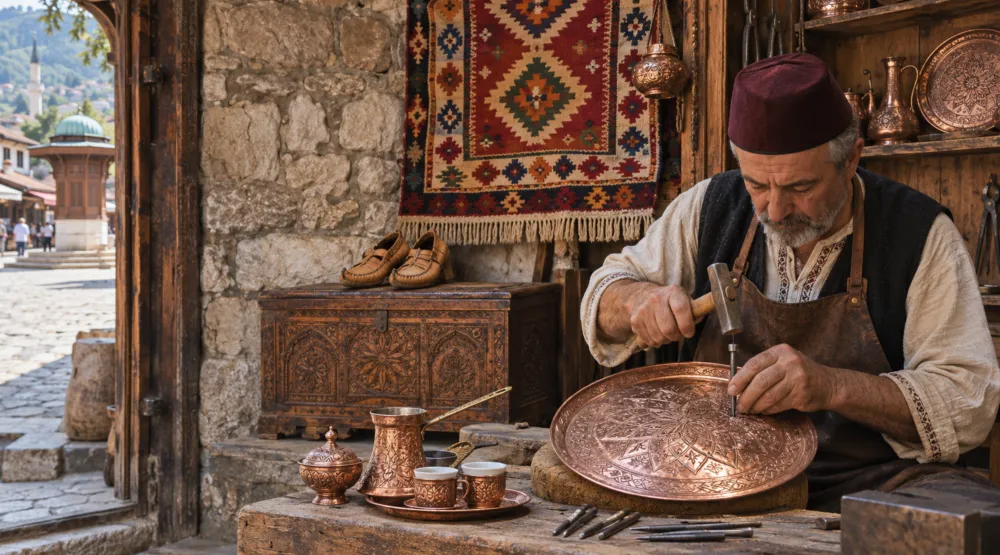
We want the people of Bosnia and Herzegovina to know that many old, traditional crafts still exist today. They survived industrialisation and modern times! Families continue to pass these skills from one generation to the next, and some crafts are kept alive in workshops and associations.
We begin this story with an unknown, tireless Bosnian woman—a weaver who worked day and night making carpets, rugs, and floor coverings. Carpets, rugs, bags, mats, blankets, and many other textile goods were traditionally made on looms. Long ago, weaving was an essential household skill in rural areas. Weavers decorated traditional clothing, headscarves, towels, and other garments. The patterns differed from one region to another.
Let’s take it one craft at a time.
First, let’s learn about coppersmithing, the craft of making objects from copper. Coppersmiths made everything from ewers and coffee pots to serving dishes, trays, and pots, along with many other beautiful copper vessels. This craft was especially common in Sarajevo’s Baščaršija. And who were the kujundžije, dear ABC Djeca, all around the world? They were artists who decorated and shaped metal, often making jewellery and ornamental items from silver and other metals. This craft has a long history in Sarajevo, Mostar, and other cities.
Blacksmiths, meanwhile, shaped iron and steel by hand, making farm tools, locks, nails, horseshoes, knives, and many other household items. Potters and skilled Bosnian craftspeople also made things from wood, such as chests, ornaments, chairs, storage boxes, headscarves, and furniture parts. What does a potter do? A potter shapes clay to make large jars and water jugs, as well as pots, bowls, and decorative objects. The tradition of handmade pottery has survived in some parts of our homeland, Bosnia and Herzegovina.
The author of these lines says he used to wear opanci. Who is an opančar, and what does this craftsperson make?
Opančari make traditional footwear, especially opanci, as well as other leather goods. In the past, opanci were everyday shoes for much of the population. I remember 1957, when I put on my very first brand-new pair of opanci and happily walked into first grade at the primary school in my hometown of Knežina!
What once was is now remembered!
Let’s move on to leatherworkers and saddlers.
What can be made from leather? Leatherworkers made straps and belts, bags, saddle bags, saddles, bridles, and many other things. Saddlery is especially connected to the tradition of horses. And what about an abadžija? Abadžije make and repair parts of traditional clothing, especially garments made from thick woollen cloth and other sturdy wool fabrics. Terzije were tailors who made richly decorated traditional clothing and were especially known for sewing and embellishing folk costumes by hand. A saddler is a leatherworker who makes horse equipment, leather bags, cases, belts, and other items.
Now we have reached the broom makers. What do they do? They make brooms by hand from sorghum, once a very common household item. Next, let’s meet basket weavers, rope makers, carpenters, knife sharpeners, and wax makers. Baskets are made from wicker, willow branches, and other natural materials. Craftspeople make baskets, sepeti, woven shopping bags, hampers, and other things. Rope makers still make different kinds of rope and cord. This craft was once very important for farming, animal husbandry, and transport. Traditional carpenters make furniture with hand tools, especially wooden chairs, tables, chests, boxes, and other items. Knife sharpeners sharpen and repair knives, scissors, farm tools, and other objects. In the past, these craftspeople travelled between villages and towns to offer their services. Finally, a wax maker works with beeswax to make candles, a craft connected to a long tradition of beekeeping. Craftspeople also used willow, hazel, and other branches to make baskets, chairs, cradles, and other woven items. Some masters still make traditional instruments such as flutes, šargije, saz, and bagpipes.
Where has the tradition been preserved most?
In many cities across Bosnia and Herzegovina: Sarajevo, Mostar, Banja Luka, Bihać, Visoko, Travnik, Gradačac, Konjic, Cazin, Foča, Tešanj, and many more…
Bosnian traditions are fascinating because people made so many things from wood, wool, leather, copper, iron, clay, stone, wicker, and wax. That is why old crafts are much more than ordinary jobs. They hold knowledge about nature, materials, and the way our ancestors lived. Today, only a small number of artisans practise some of them, so that knowledge could disappear if younger generations do not learn it. As many as fifty crafts developed in Bosnian cities, and some are still practised today!
Many artisans eagerly followed the creation of the “Encyclopedia of Old Crafts of Bosnia and Herzegovina.” Our beautiful homeland has an exceptionally rich craft tradition. Some crafts in Sarajevo date back to the 15th century. The oldest known Sarajevo register from 1489 mentions blacksmiths, shoemakers, saddlers, butchers, and bakers, among others. Later records include coppersmiths, silversmiths, shoemakers, farriers, and many others. By the end of the 19th century, about 70 different crafts and around 400 kinds of products were recorded in Sarajevo!
Some of these skills are still practised today. In 2022, the Federation of Bosnia and Herzegovina adopted a special Regulation on the Protection of Traditional and Old Crafts. It established an official list of crafts and a legal framework for practising them.
Next, a few words about the woodcarvers of Konjic.
This is one of Bosnia and Herzegovina’s most treasured living crafts. Artisans carve furniture, chests, tables, chairs, wall panels, boxes, and ornaments by hand, using distinctive geometric and plant patterns. Konjic woodcarving has a history of more than a century. In 2017, it was added to UNESCO’s Representative List of the Intangible Cultural Heritage of Humanity. UNESCO highlights how this knowledge is passed on through family traditions and hands-on training in workshops.
To finish, a few lines about weavers, spinners, embroiderers, and Zmijanje embroidery.
Zmijanje embroidery is a special art form associated with the Zmijanje region. It is recognised by its dark blue colour and intricate geometric patterns. It was added to UNESCO’s list in 2014! Other traditional skills include carpet weaving, making traditional clothes, lace-making known as keranje, knitting, rope-making, and decorating folk costumes. Sarajevo’s crafts were more than just production: artisans organised themselves into guilds, professional associations that set craft rules, training, and relationships between masters. We should not automatically assume that every activity now called an “old craft” is still practised today! Some crafts have disappeared completely, some survive only in traces, and others are still practised professionally.
We’ll be waiting for you, dear ABC Djeca boys and girls, on a craft street in one of our markets—in our one and only Bosnia and Herzegovina!